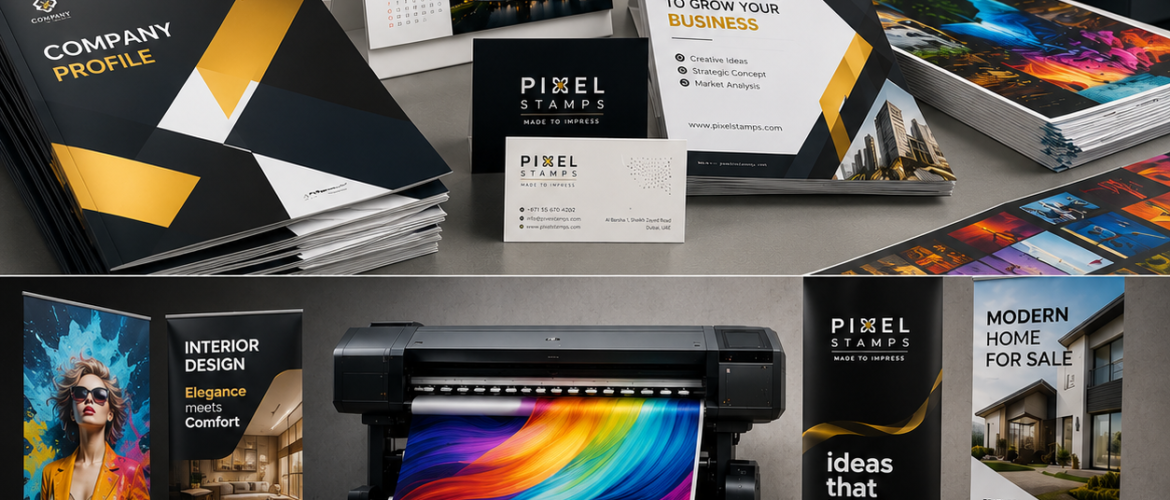
Digital vs Offset Printing: Which Is Best for Your Business?
Which Print Method Actually Fits Your Job?
Introduction
Ask two different print shops which is better, digital printing or offset printing, and you will often get two different answers — usually depending on which machines that shop happens to run. The honest answer is that neither method is universally “better.” Each is suited to different order sizes, budgets, and turnaround needs, and choosing the wrong one for your job either wastes money or costs you time you did not need to lose.
At Pixel Stamps, we run both digital and offset printing from our Al Barsha workshop, which means we are not trying to push every client toward one method regardless of fit. This guide explains the practical differences so you can make the right call for your next print run.
Why This Decision Actually Affects Your Bottom Line
Print method affects three things a business cares about directly: cost per unit, turnaround time, and colour consistency across a large run. Getting the choice wrong on a large order can mean paying significantly more per piece than necessary, or on a small order, waiting far longer and paying more for setup than the job justified.
1. How Digital Printing Works
Digital printing works much like a high-end office printer — the design goes straight from a digital file to the printed sheet, with no plates or setup process required. This makes it fast to start and ideal for smaller quantities, since there is no setup cost to spread across the run.
Digital printing is generally the better choice for:
- Small to medium print runs, from single copies up to a few hundred pieces
- Jobs needing personalization, such as variable names or numbers on each piece
- Tight deadlines, since there is no plate-making delay before production starts
- Businesses that reorder small batches frequently rather than one large run
2. How Offset Printing Works
Offset printing transfers ink from printing plates onto a rubber blanket and then onto the paper. Creating those plates takes time and adds a setup cost, but once production is running, offset delivers extremely consistent colour and very low cost per unit at high volumes.
Offset printing is generally the better choice for:
- Large print runs, typically from a thousand pieces upward
- Jobs requiring precise, consistent colour matching across every sheet
- Specialty inks, such as Pantone spot colours, that digital printers cannot always reproduce accurately
- Long-term print materials where the lowest possible per-unit cost matters most
3. Comparing Digital and Offset Printing
| Factor | Digital Printing | Offset Printing |
| Best Run Size | Small to medium (1–a few hundred) | Large (1,000+) |
| Setup Time | Minimal, fast start | Longer, plates required |
| Cost Per Unit (Large Run) | Higher | Lower |
| Cost Per Unit (Small Run) | Lower | Higher due to setup cost |
| Personalization/Variable Data | Yes, easily | Not practical |
| Colour Consistency at Scale | Good | Excellent |
4. Turnaround Time Is Often the Deciding Factor
In practice, deadline pressure decides many print method choices before cost even enters the conversation. A client who needs 300 brochures for a meeting tomorrow will almost always go digital, regardless of what the cost-per-unit comparison shows for a larger run, simply because offset’s plate-making process cannot be rushed the same way.
5. Quality Considerations Beyond Cost
For most modern digital presses, everyday print quality is excellent and often indistinguishable from offset to the average eye. The gap becomes noticeable mainly with large solid colour blocks, specific brand colours that require exact Pantone matching, or premium finishes like foiling that pair more naturally with offset production. For typical business collateral — brochures, flyers, business cards, forms — either method will usually produce a satisfactory result, which is why run size and turnaround tend to matter more than a quality gap.
6. Paper and Material Compatibility
Both methods work across a wide range of paper stocks, but offset presses generally handle heavier, textured, or specialty papers more consistently across a long run, since the ink transfer process is more stable at scale. Digital presses have improved significantly on this front, but for premium stock with unusual textures at high volume, it is worth checking compatibility before committing to a print method.
7. Getting a Quote That Actually Compares Apples to Apples
When comparing quotes between digital and offset for the same job, make sure the quantity, paper stock, and finishing are identical on both sides. It is common for a quote to look cheaper simply because it specifies a lighter paper or fewer colours, which is not a fair comparison. At our workshop, we typically walk clients through both options side by side for borderline quantities — usually in the low thousands — where either method could reasonably work.
Common Mistakes to Avoid
- Choosing offset for a small run and paying unnecessarily for plate setup
- Choosing digital for a very large run and paying a higher cost per unit than offset would have offered
- Assuming exact brand colour matching without confirming Pantone requirements upfront
- Not building in enough lead time for an offset job with a tight brand-colour requirement
- Not asking for a printed proof before a large offset run, where reprints are costly
Who Uses Digital vs Offset Printing in Dubai?
Startups, small businesses, and clients needing quick, personalized, or short-run print jobs tend to lean digital. Larger corporates, retail chains, and businesses ordering annual stock of packaging, forms, or branded stationery in bulk tend to lean offset, where the lower per-unit cost at scale makes a meaningful difference to the budget.
8. When the Two Methods Are Combined
Some businesses use a hybrid approach — an offset run for the bulk of a print job, such as packaging or long-life stationery, supplemented by digital reprints for smaller top-up quantities between larger orders. This can be a practical way to get offset’s low unit cost on the bulk order while still having a fast, low-commitment way to restock smaller quantities later without waiting on a full plate setup again.
Frequently Asked Questions About Digital and Offset Printing
Which is cheaper, digital or offset printing?
It depends on quantity. Digital is cheaper for small runs since there is no plate setup cost, while offset becomes more cost-effective as quantities grow into the thousands.
Can digital printing match an exact brand colour?
Digital printing can get close to most brand colours, but for exact Pantone spot colour matching, offset printing is generally more reliable.
Is digital printing good enough for professional business materials?
Yes, modern digital printing produces high-quality results suitable for brochures, business cards, and most everyday business collateral.
How long does an offset print job take compared to digital?
Offset generally takes longer to start due to plate preparation, while digital printing can begin almost immediately, making it the better option under tight deadlines.
Can I personalize each piece with digital printing?
Yes, digital printing supports variable data, meaning each piece can have a different name, number, or detail without slowing down production.
Conclusion
Neither digital printing nor offset printing is the “better” method in general — the right choice depends on your quantity, deadline, and colour requirements. Small, urgent, or personalized jobs generally suit digital, while large, colour-critical runs generally suit offset.
At Pixel Stamps, we run both digital and offset printing in-house from our Al Barsha workshop, so we can recommend the method that actually fits your job rather than the one machine we happen to own.
Related Guides
- Brochure vs Flyer Printing: Choosing the Right Marketing Print in Dubai
- Large Format Printing in Dubai: Banners & Roll-Up Stands Guide
Order Digital or Offset Printing from Pixel Stamps
Not sure which method fits your print job? Send us your quantity and deadline and we will recommend the right option.
📞 Call / WhatsApp: +971 556 704 282
📧 Email: info@pixelstamps.com
🌐 Website: pixelstamps.com/digital-printing-offset-printings